What Is a Vehicle Battery Checker and How Does It Work?
A Vehicle Battery Checker is a practical instrument for understanding what happens beneath a vehicle’s bonnet. It measures battery voltage, starting performance, and sometimes charging-system output. A technician connects its clamps to the battery terminals. The screen then displays figures that may reveal weak capacity, poor connections, or a developing starting problem.
It is not magic. A digital checker often applies a small electrical load or uses conductance testing. It compares the battery’s response with its rated cold-cranking amps. A healthy 12-volt battery may show about 12.6 volts when fully charged and resting. However, voltage alone cannot prove battery health. Surface charge, temperature, corrosion, and recent driving can distort the reading.
As Isidor Buchmann, founder of Cadex Electronics and Battery University, explains, “The battery is a chemical device, not a fuel tank.” This reminder matters during testing. A battery can appear strong after a short drive, then struggle after sitting overnight. In my view, the best checker supports careful diagnosis rather than replacing professional judgment. It should be used with a visual inspection, terminal cleaning, and charging-system test. Results can still be imperfect. That uncertainty deserves attention.
This guide explains how a Vehicle Battery Checker works, what its readings mean, and where common testing mistakes occur. You will see how load tests differ from conductance tests. You will also learn when a warning result requires further inspection. Small details matter, especially a loose clamp or a cracked battery case.
What Is a Vehicle Battery Checker?
What Is a Vehicle Battery Checker and How Does It Work?
What Is a Vehicle Battery Checker?
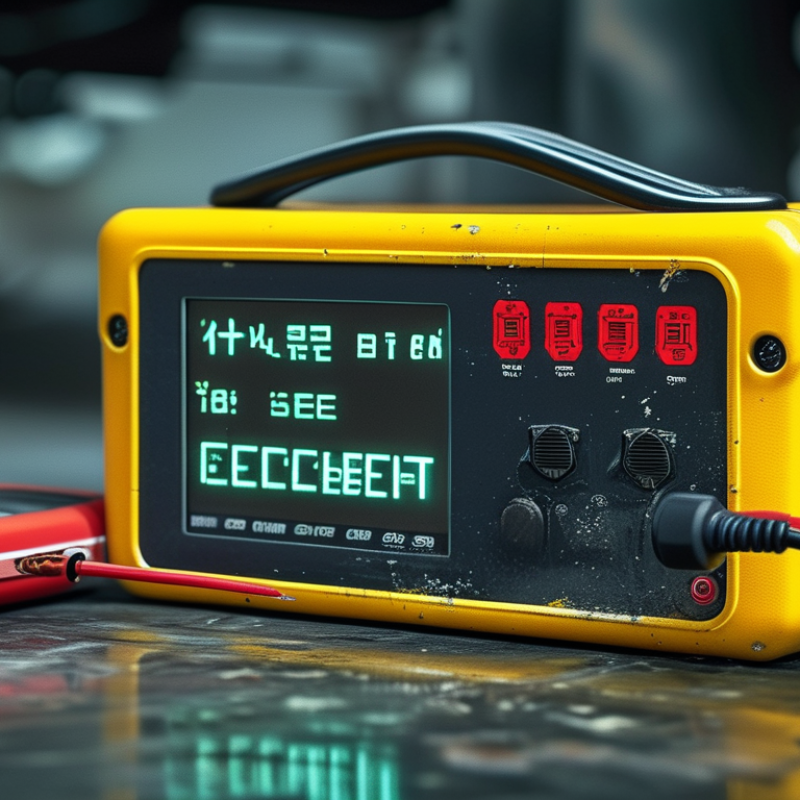
A vehicle battery checker is a handheld tool that evaluates a battery’s electrical condition. It measures voltage, starting power, and sometimes internal resistance. Some models use a controlled load, while others use electronic conductance testing. The checker compares these readings with the battery’s rated cold-cranking amps, or CCA.
A healthy battery usually shows about 12.6 volts when fully charged and resting. Around 12.2 volts may indicate partial discharge. That number alone can mislead. A weak battery can display normal voltage but collapse during engine cranking. Modern checkers therefore estimate state of health, not only charge level. Read the result carefully.
The 2024 ADAC Breakdown Statistics reported that starter-battery problems caused 44.1% of recorded vehicle breakdowns in its dataset. This figure shows why testing matters, especially before winter travel. The U.S. Department of Energy also identifies temperature, age, and repeated shallow charging as important factors in battery performance.
In practice, a technician switches off the vehicle, connects the clamps correctly, and enters the battery’s CCA rating. The checker then applies a brief electronic test. Corroded terminals can distort the result. So can a recently charged battery. I have found that a second test after a short rest often gives a more realistic reading. Test again. Conditions matter.
What Is a Vehicle Battery Checker and How Does It Work?
| Data Dimension | Description | Typical Value or Range | What the Result Indicates |
|---|---|---|---|
| Primary purpose | A vehicle battery checker measures electrical characteristics to assess a battery’s charge level, starting capability, and general condition. | Voltage, current response, and sometimes conductance or resistance | Helps determine whether the battery is charged, weak, or likely to need replacement. |
| Battery system voltage | The nominal voltage of the vehicle’s low-voltage electrical system. | Approximately 12 V for most passenger vehicles; approximately 24 V for some heavy-duty systems | The tester must be compatible with the battery system being checked. |
| Open-circuit voltage after resting | Voltage measured with the engine off and surface charge dissipated, preferably after several hours without charging or starting. | About 12.6–12.8 V: fully charged; about 12.4 V: approximately 75%; about 12.2 V: approximately 50%; about 12.0 V: substantially discharged | Estimates state of charge, but does not independently prove that the battery can deliver starting current. |
| Charging-system voltage | Voltage measured while the engine is running to evaluate the alternator and charging circuit. | Commonly about 13.7–14.7 V, depending on vehicle design, temperature, and charging strategy | A significantly low or high reading may suggest a charging-system fault; the vehicle service specification should be followed. |
| Cold-cranking capability | The battery’s ability to supply high current for engine starting under cold-test conditions. | Reported in cold-cranking amps (CCA), according to the rating printed on the battery | A result close to or above the battery’s rated CCA generally indicates adequate starting ability. |
| Load-test method | Applies a controlled electrical load while monitoring voltage behavior. | A load near one-half of the battery’s CCA rating for about 15 seconds is a commonly used conventional test condition | For a fully charged 12 V battery, voltage is commonly expected to remain at or above approximately 9.6 V at about 21°C; temperature affects the result. |
| Electronic conductance test | Sends a small signal through the battery and estimates internal conductance, resistance, and available starting performance. | Usually displays estimated CCA, battery condition, and state of charge | Provides a quick, low-load assessment, but results can be affected by surface charge, temperature, and incorrect battery information. |
| Battery condition categories | Many testers classify the result using simple status messages. | Good; recharge and retest; weak or replace; charging-system fault | The interpretation should be combined with voltage, test conditions, battery age, and vehicle symptoms. |
| Battery technologies | Different battery constructions may require different test settings and evaluation methods. | Flooded lead-acid, AGM, and gel lead-acid batteries are common 12 V types | Selecting the correct battery type improves test accuracy and reduces the risk of misinterpretation. |
| Testing sequence | A basic check normally includes visual inspection, connection, resting-voltage measurement, and a load or conductance test. | Clean, secure terminals; correct polarity; accurate battery rating entered when required | Correct preparation helps prevent false readings and protects the tester from reverse-polarity connections. |
| Important limitations | A checker evaluates electrical performance at the time of testing; it cannot guarantee future battery life. | Accuracy may be reduced by extreme temperature, recent charging, corrosion, low state of charge, or a parasitic load | Recharge and retest when appropriate, and consult the vehicle service procedure for borderline results. |
Note: Voltage ranges are general reference values for conventional 12 V lead-acid vehicle batteries. Actual specifications vary with battery design, temperature, vehicle charging strategy, and the tester’s measurement standard.