How to Choose an Indoor Trampoline Park Manufacturer?
Choosing an indoor trampoline park manufacturer is a safety, design, and business decision, not merely a purchasing task. The right partner must understand visitor flow, structural loads, impact protection, fire safety, maintenance access, and local approval requirements. Indoor Trampoline Park Design Manufacturing should connect creative layouts with documented engineering evidence. A colorful rendering means little if anchors, padding, or emergency routes remain unclear.
Industry research supports careful evaluation. IAAPA’s Global Economic Impact Study, produced with Oxford Economics, shows the broad economic importance of the attractions industry and its contribution to employment and visitor spending. Grand View Research also identifies indoor entertainment and active recreation as expanding commercial segments, although market growth alone does not prove supplier quality. ASTM F2970 provides recognized guidance for trampoline court design, installation, inspection, and operation. Manufacturers should explain how their systems address these expectations, even when local standards differ.
Ask for project references, material certificates, structural calculations, inspection records, and a realistic replacement schedule. Visit an operating park if possible. Watch how children move between courts, how staff reach equipment, and where worn foam appears first. Ask who responds after installation. This is often overlooked.
I would challenge one assumption: the lowest quotation is rarely the lowest lifetime cost. A stronger evaluation compares warranty terms, spare-part availability, staff training, cleaning requirements, and redesign support. Reliable manufacturers communicate limitations clearly. They also admit when a proposed feature needs revision. That honesty may be more valuable than an impressive sales presentation.
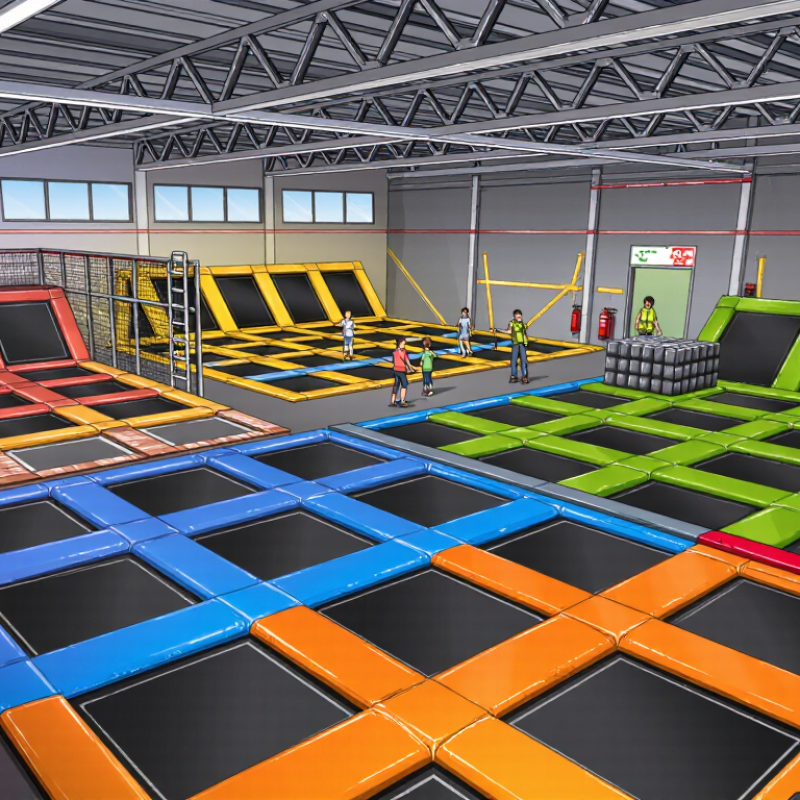
Define Your Indoor Trampoline Park Project Requirements
Define Your Indoor Trampoline Park Project Requirements
Choosing an indoor trampoline park manufacturer starts with a clear project brief. Define the venue size, ceiling height, visitor capacity, activity zones, age groups, and expected peak hours. A 1,000-square-meter venue needs a different layout from a compact family entertainment center. Record every measurement. Small errors can affect evacuation routes, supervision, and equipment spacing.
Industry data can guide your assumptions. A 2024 Grand View Research report estimates the global trampoline park market will continue growing strongly through 2030. That growth increases competition and raises visitor expectations. Your plan should include more than wall trampolines. Consider dodgeball courts, toddler areas, climbing features, party rooms, reception space, storage, and staff sightlines. ASTM F2970 provides recognized guidance for trampoline court design, installation, operation, and maintenance. Ask manufacturers how their proposals address these requirements. Do not accept vague safety claims.
Tips: Prepare a floor plan before requesting quotations. List electrical capacity, flooring conditions, fire protection limits, and local inspection needs. Request maintenance schedules, training materials, load calculations, warranty terms, and replacement-part availability. Visit an operating facility if possible. Watch how staff manage queues and clean high-contact surfaces. My first layout would probably be too crowded. Leave more circulation space than your initial drawing suggests. A beautiful plan can still fail during a busy Saturday afternoon.
| Project Requirement | Recommended Planning Data | What to Confirm with the Manufacturer | Why It Matters |
|---|---|---|---|
| Available Facility Area | Approximately 800–2,500 m² for a small to medium indoor park | Request a layout based on the exact length, width, columns, entrances, exits, and usable floor area. | The available area determines the number of attractions, circulation space, reception zones, and party rooms. |
| Clear Ceiling Height | Preferably 5.5–8 m of unobstructed vertical clearance | Verify clearance below beams, lighting, sprinklers, ventilation ducts, and other overhead equipment. | Sufficient height is important for safe jumping, climbing features, basketball activities, and maintenance access. |
| Target Customer Groups | Children aged 3–6, children aged 7–12, teenagers, adults, or mixed users | Ask for age-specific zones, separate activity rules, suitable equipment sizes, and visual supervision solutions. | Different age groups require different jump areas, impact protection, operating procedures, and supervision levels. |
| Expected Daily Visitors | Plan capacity from estimated peak-hour demand rather than average daily attendance | Confirm recommended occupancy, entry intervals, queue space, staffing assumptions, and emergency evacuation capacity. | Capacity planning affects revenue potential, visitor comfort, safety management, and the size of support areas. |
| Trampoline Area Allocation | Commonly 35%–55% of the total customer-accessible activity area | Review the ratio of standard trampolines to angled trampolines, foam pits, dodgeball courts, and performance zones. | A balanced layout provides varied activities while preserving safety distances and clear walkways. |
| Attraction Mix | Possible features include open jump areas, foam pits, airbag landings, climbing walls, ninja elements, and sports courts | Compare each attraction by footprint, age suitability, fall height, operating restrictions, maintenance needs, and replacement parts. | The attraction mix influences customer appeal, ticket pricing, repeat visits, and operational complexity. |
| Safety and Impact Protection | Use padded frames, protected steel structures, safety netting, impact-absorbing surfaces, and controlled access points | Request material specifications, padding thickness, stitching details, anchor methods, inspection procedures, and test documentation. | Safety design reduces injury risks and supports consistent daily inspections and staff training. |
| Relevant Standards and Local Approval | Requirements vary by country, municipality, building type, and attraction category | Confirm applicable amusement-equipment, fire-safety, building, accessibility, electrical, and occupational-safety requirements before production. | Early compliance planning helps prevent installation delays, redesign costs, and approval problems. |
| Flooring and Subfloor Conditions | Level, structurally adequate flooring with suitable shock absorption and moisture protection | Confirm required floor flatness, load-bearing capacity, anchoring method, drainage conditions, and protection for existing floors. | Floor conditions affect installation quality, equipment stability, impact performance, and long-term durability. |
| Accessibility and Visitor Flow | Provide accessible routes, clear circulation paths, suitable check-in space, and separate staff access where possible | Review wheelchair routes, viewing areas, lockers, changing rooms, emergency exits, queue control, and customer flow. | A well-planned flow improves visitor experience and helps staff supervise the park efficiently. |
| Budget Structure | Separate the budget into equipment, shipping, installation, flooring, building work, permits, signage, and contingency | Request a detailed quotation with inclusions, exclusions, taxes, packaging, spare parts, installation labor, and payment milestones. | A complete cost structure prevents hidden expenses and supports a realistic return-on-investment analysis. |
| Project Schedule | Allow time for design approval, engineering, manufacturing, shipping, installation, inspection, and staff training | Obtain a milestone schedule and identify information that must be supplied before design and production can begin. | Clear scheduling helps coordinate construction, lease commitments, marketing, recruitment, and opening preparations. |
| Customization Requirements | Define colors, theme, signage, logo placement, attraction layout, lighting, and optional digital features | Ask which elements are standard, which are custom-made, and how customization affects cost, lead time, cleaning, and replacement. | Customization can strengthen the park concept, but excessive complexity may increase cost and maintenance demands. |
| Maintenance and Spare Parts | Plan routine inspections, cleaning, component replacement, and periodic professional maintenance | Confirm spare-part availability, replacement intervals, maintenance manuals, inspection checklists, and technical support response times. | Reliable maintenance protects safety, minimizes downtime, and extends the service life of the equipment. |
| Warranty and After-Sales Support | Evaluate coverage for structural components, padding, springs, nets, stitching, and installation workmanship | Check warranty duration, exclusions, claim procedures, remote support, on-site service, and responsibility for transport costs. | Strong after-sales support reduces operational risk after the park opens. |
| Installation and Staff Training | Include professional installation, equipment inspection, operating procedures, and emergency-response training | Confirm installation team qualifications, handover documents, staff training hours, and post-installation inspection arrangements. | Correct installation and trained staff are essential for safe daily operation and consistent visitor management. |
Planning figures are general industry benchmarks. Final requirements should be verified against the facility drawings, local regulations, fire-safety conditions, structural assessments, and the selected attraction design.