China Top 10 Terminal Block Manufacturers for Global Buyers
Choosing a reliable Terminal Block manufacturer is a practical decision, not a simple popularity contest. Global buyers must examine contact materials, rated voltage, current capacity, insulation quality, and production consistency. A polished catalogue proves little by itself. Factory evidence matters more.
Markus Kiefer, a veteran terminal-block design engineer, once observed, “A terminal block is small, but it carries the responsibility of the entire circuit.” That principle deserves attention. A loose clamp can create heat, downtime, or a difficult field repair. Buyers should therefore inspect spring or screw-clamp performance, wire-size compatibility, flame-retardant housing materials, and test documentation. Certification marks should also be verified through current, traceable records. Standards and approvals can vary by application and destination market.
This guide introduces ten leading Terminal Block manufacturers serving international customers. It considers product range, engineering capability, customization, quality control, export experience, and after-sales support. It also looks at details often missed during supplier comparisons, such as packaging protection, labeling accuracy, sample response time, and technical drawings.
No ranking is perfect. Buyer priorities differ. A control-panel builder may value compact DIN-rail terminals, while a renewable-energy project may require stronger environmental resistance. Price can mislead. The cheapest quotation may exclude tooling, testing, or dependable documentation. Readers should use this list as a starting point, then request samples and review application-specific evidence. Careful comparison takes time. It usually prevents expensive surprises.
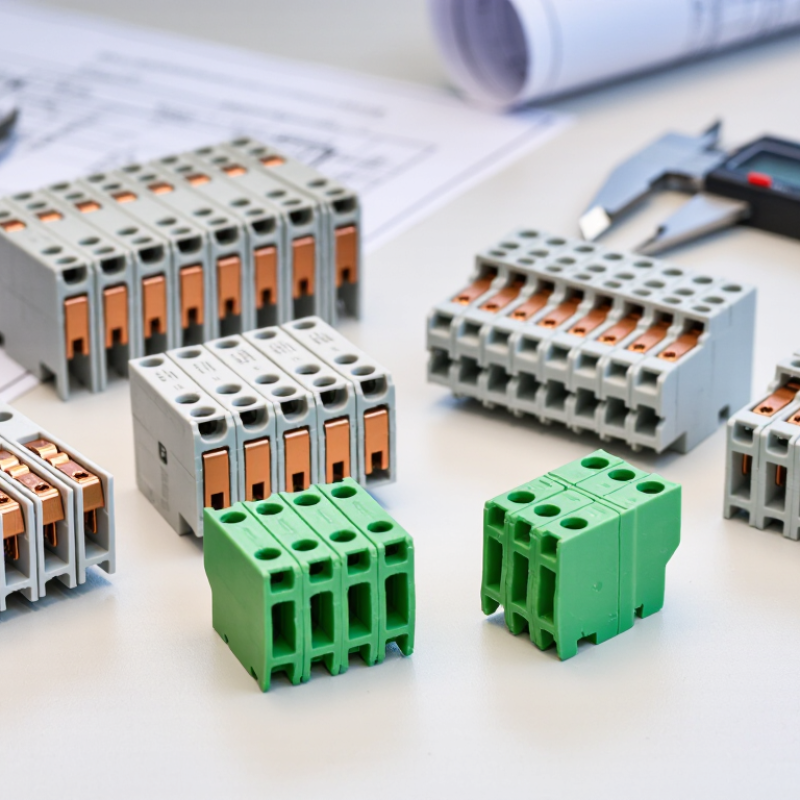
Terminal Block Basics for Global Industrial Applications
Terminal blocks are modular connectors that join wires safely inside control panels, machines, and distribution equipment. Their metal clamps carry current, while insulated housings reduce accidental contact. Common forms include feed-through, ground, fuse, disconnect, and multi-level blocks. Selection starts with voltage, current, wire size, pitch, and mounting method. These details must match the actual installation, not only the catalog description.
A reliable evaluation also checks insulation material, temperature rating, flammability performance, and resistance to vibration. Screw clamps suit many maintenance environments, while spring connections can reduce retightening work. In dusty factories, sealed enclosures and suitable ingress protection matter. Marine or outdoor installations demand stronger corrosion considerations. Small details matter. A loose conductor can create heat within minutes.
Global applications require careful review of regional standards and test reports. Buyers should request clear markings, traceable quality records, and samples for torque, pull-out, and temperature-rise checks. Wire entry should remain straight, with no crushed strands or excessive bending. Derating is easy to overlook when many circuits share one narrow cabinet. I have seen technically correct selections fail after poor installation planning. The component was not always the problem. Sometimes the spacing, tool access, or heat path was underestimated. A practical checklist, verified with the panel builder, often exposes these weaknesses before production.
China Top 10 Terminal Block Manufacturers for Global Buyers - Terminal Block Basics for Global Industrial Applications
| Profile | Terminal Block Type | Typical Industrial Application | Mounting or Installation | Connection Method | Typical Wire Range | Typical Rated Voltage | Typical Rated Current | Common Materials | Relevant International Standards |
|---|---|---|---|---|---|---|---|---|---|
| 01 | Feed-Through Terminal Block | Control cabinets, machine wiring, power distribution and general panel interconnection | 35 mm DIN rail | Screw clamp or spring clamp | 0.2–35 mm² | 300–1,000 V AC/DC | 10–125 A | Polyamide or other engineering thermoplastic; copper-alloy conductor parts | IEC 60947-7-1; UL 1059 |
| 02 | Protective Earth Terminal Block | Protective conductor connections and equipotential bonding in electrical enclosures | 35 mm DIN rail with metal rail contact | Screw clamp or spring clamp | 0.5–35 mm² | Up to 1,000 V AC/DC | 10–125 A | Green/yellow insulating body; tin-plated or zinc-plated metal parts | IEC 60947-7-2; IEC 60445 |
| 03 | Fuse Terminal Block | Branch-circuit protection, instrument circuits and control-panel overcurrent protection | 35 mm DIN rail | Screw clamp, spring clamp or hinged fuse carrier | 0.2–10 mm² | 250–800 V AC/DC | 2–32 A | Flame-retardant thermoplastic; copper-alloy terminals; replaceable fuse carrier | IEC 60947-7-3; IEC 60269 |
| 04 | Disconnect or Test Terminal Block | Testing, isolation and fault diagnosis for control, measurement and automation circuits | 35 mm DIN rail | Knife disconnect, plug disconnect or test socket | 0.2–10 mm² | 250–800 V AC/DC | 6–41 A | Flame-retardant thermoplastic; copper-alloy current path | IEC 60947-7-1; IEC 60947-7-3 |
| 05 | Multi-Level Terminal Block | High-density PLC, relay, HVAC and instrumentation control cabinets | 35 mm DIN rail | Screw clamp or spring clamp | 0.2–6 mm² | 300–800 V AC/DC | 6–32 A | Compact flame-retardant thermoplastic; copper-alloy contacts | IEC 60947-7-1; UL 1059 |
| 06 | Sensor and Actuator Terminal Block | Proximity sensors, photoelectric sensors, valves, actuators and field I/O wiring | 35 mm DIN rail | Push-in or spring clamp | 0.14–4 mm² | 150–500 V AC/DC | 2–16 A | Flame-retardant thermoplastic; copper-alloy contacts; optional LED indication | IEC 60947-7-1; IEC 60529 where enclosure protection applies |
| 07 | Thermocouple or Temperature Terminal Block | Temperature measurement, process control and industrial instrumentation | 35 mm DIN rail or panel mounting | Screw clamp or spring clamp | 0.14–4 mm² | 50–300 V AC/DC | 1–10 A | Thermoplastic body; matched thermocouple alloy or compatible contact materials | IEC 60584 for thermocouple types; IEC 60947-7-1 for terminal construction |
| 08 | High-Current Power Terminal Block | Motor control centers, power supplies, battery systems and industrial distribution panels | 35 mm DIN rail, direct panel or busbar mounting | Stud, bolt, screw clamp or cage clamp | 16–240 mm² | 600–1,000 V AC/DC | 80–415 A | High-temperature insulating material; copper or aluminum-compatible current path | IEC 60947-7-1; UL 1059 |
| 09 | PCB Terminal Block | Industrial controllers, power supplies, instrumentation and embedded control equipment | Printed circuit board; pluggable or fixed mounting | Wire clamp, spring clamp or screw clamp | 0.2–6 mm² | 150–600 V AC/DC | 2–41 A | Flame-retardant thermoplastic; tin-plated copper-alloy contacts | IEC 60998-2-1; IEC 60947-7-1; UL 1059 |
| 10 | Barrier Terminal Block | Power supplies, transformers, HVAC equipment, lighting controls and OEM machinery | Panel or chassis mounting | Rising clamp, screw clamp or stud connection | 0.5–16 mm² | 300–600 V AC/DC | 10–100 A | Flame-retardant thermoplastic or thermoset body; copper-alloy terminals | IEC 60998-2-1; UL 1059 |
Note: Electrical ratings are typical application ranges for each terminal-block category. Actual ratings depend on conductor size, ambient temperature, spacing, pollution degree, installation method and the applicable product datasheet.