10 Best Agricultural Bearings for Global Buyers
Choosing the right Agricultural bearing can determine whether a harvesting machine runs smoothly or stops during a critical field operation. Dust, mud, fertilizer residue, vibration, and uneven loads create demanding conditions. A bearing may look suitable in a catalogue, yet fail quickly under real farm conditions.
This guide, “10 Best Agricultural Bearings for Global Buyers,” examines practical options for tractors, combines, planters, balers, and irrigation equipment. It considers load capacity, sealing performance, corrosion resistance, lubrication needs, mounting design, operating speed, and replacement availability. Buyers should also verify shaft dimensions, housing compatibility, manufacturer documentation, and regional supply support. Small measurement errors can cause expensive downtime.
Tribology expert Peter J. Blau offers a useful principle: “Wear is not a material property; it is a system response.” That idea matters here. Bearing life depends on the complete operating environment, not only steel grade or brand reputation. A well-sealed unit may outperform a stronger bearing when fields are wet and dusty. However, no product is ideal everywhere.
No ranking is perfect. Crop type, machine age, maintenance habits, and climate can change the result. Grease intervals are often ignored. Alignment problems are sometimes blamed on the bearing. This guide keeps those imperfections visible while comparing dependable choices for global buyers. It focuses on evidence, practical experience, and transparent selection criteria. The goal is not to promote the most expensive Agricultural Bearing. It is to identify the most suitable option for each working condition.
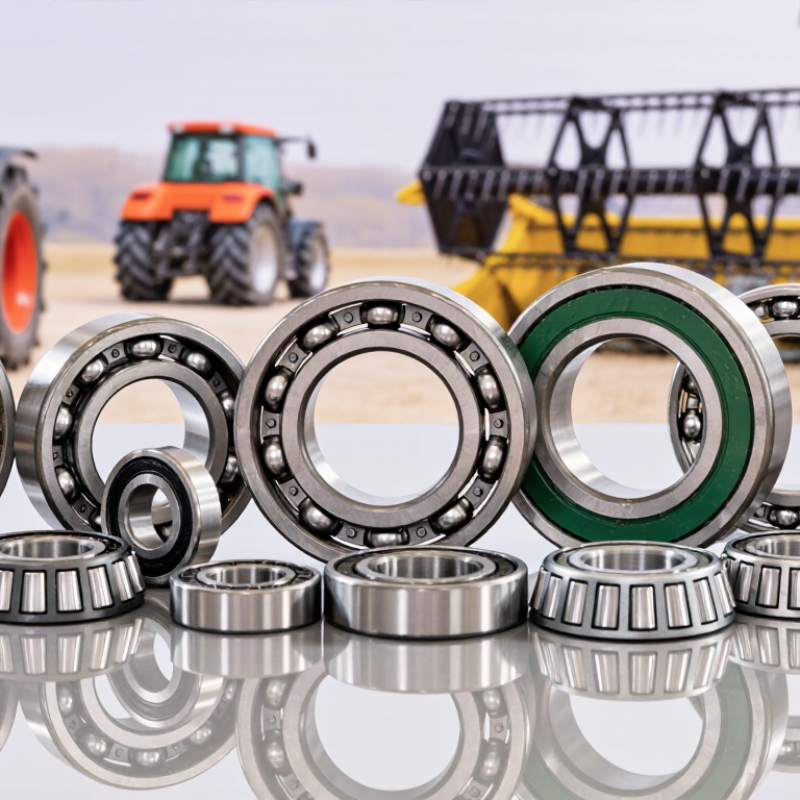
What Agricultural Bearings Are and Why They Matter
10 Best Agricultural Bearings for Global Buyers
What Agricultural Bearings Are and Why They Matter
Agricultural bearings support rotating shafts in equipment such as planters, harvesters, balers, and irrigation machines. They reduce friction between moving parts. Common types include deep-groove, spherical roller, tapered roller, needle, thrust, and flange bearings. Insert bearings often handle moderate loads and simple mounting. Spherical designs tolerate shaft misalignment. Tapered rollers manage combined radial and axial forces.
Their working conditions are demanding. Dust enters through dry soil. Water reaches components during cleaning or rain. Crop residue can wrap around exposed housings. Shock loads also occur when machinery crosses uneven ground. A suitable bearing needs correct load capacity, sealing, clearance, and lubrication. Choosing only by shaft diameter is a weak decision.
Field maintenance shows a practical truth: many failures begin with contamination, not poor manufacturing. A bearing may look clean outside. Internal damage can already exist. Check unusual noise, rising temperature, vibration, and loose movement. Grease should match the operating speed and environment. Over-lubrication can create heat. Under-lubrication causes rapid wear. Neither choice is harmless.
The ten best agricultural bearing options are not identical for every machine. A grain auger may need strong radial support. A disc harrow may need better sealing and shock resistance. Buyers should review operating speed, seasonal storage, washdown habits, and replacement access. I would also question catalog ratings without installation details. Real performance depends on the housing, shaft fit, alignment, and daily care.
Key Factors Global Buyers Should Consider Before Choosing
10 Best Agricultural Bearings for Global Buyers
Choosing among the ten best agricultural bearings requires more than comparing prices. Start with the machine’s load, speed, shaft size, and working direction. Deep-groove bearings suit lighter radial loads, while spherical roller bearings handle misalignment and heavier equipment. Tapered roller bearings perform well under combined radial and axial forces. Thrust bearings are useful when vertical pressure dominates. Insert bearings, flanged bearings, needle bearings, pillow-block units, disc-harrow bearings, and baler bearings each serve different field conditions.
Dust and moisture often decide service life. A bearing operating beside a planter may face soil, fertilizer residue, and sudden temperature changes. Check the seal design, grease compatibility, operating temperature, and corrosion resistance. For outdoor equipment, sealed or shielded construction can reduce maintenance. However, sealing is not magic. Poor installation can damage the lip before the machine reaches the field.
Global buyers should also verify dimensional standards, traceability, test records, packaging, and replacement availability. I have seen buyers focus on unit cost and overlook downtime during harvest. That mistake becomes expensive quickly. Ask for rated load data, clearance values, lubrication guidance, and inspection procedures. Confirm whether the supplier can maintain consistent batches. A perfect catalog specification may still fail in muddy conditions. Measure the actual shaft and housing. Do not rely only on old drawings. Field feedback matters, though it can be incomplete. The best choice balances engineering data, local climate, maintenance skills, and realistic operating schedules.
The 10 Best Agricultural Bearing Types for Different Applications
Agricultural machines face dust, shock loads, water, and long idle periods. Choosing the right bearing type matters more than choosing the largest size. FAO AQUASTAT reports that agriculture uses about 70% of global freshwater withdrawals, making reliable irrigation equipment especially important. Deep-groove ball bearings suit seed drills and small conveyors. Insert bearings handle dusty, misaligned shafts. Spherical roller bearings support heavy loads in combines. Tapered roller bearings manage wheel hubs and strong radial-axial forces. Cylindrical roller bearings fit high-load gearboxes. Needle roller bearings work where space is limited. Thrust ball bearings support vertical auger loads. Angular-contact ball bearings suit precision pump shafts. Spherical plain bearings tolerate oscillation in linkage joints. Flanged bearings simplify mounting inside compact housings.
The choice should follow load, speed, sealing, and contamination data. ISO 281 rating-life calculations remain useful, but field conditions often reduce theoretical life. The U.S. Department of Agriculture’s machinery guidance repeatedly emphasizes preventive maintenance, especially during harvest periods. Moisture can enter through damaged seals. Fine soil can act like grinding paste. That detail is easy to underestimate. In my experience, a bearing with excellent laboratory ratings may still fail after one poorly protected washdown.
Tips: Check shaft alignment before installation. Use sealed units near soil and spray. Select stainless or corrosion-resistant materials for wet irrigation zones. Keep grease compatible with the operating temperature. Record vibration, noise, and temperature changes. Do not rely on appearance alone. A clean bearing can still have hidden raceway damage. Recheck the specification after the first season, because actual dust and load patterns may differ from the original design.
How to Source, Install, and Maintain Agricultural Bearings Globally
10 Best Agricultural Bearings for Global Buyers
Global sourcing starts with the field, not the catalog. Choose insert ball bearings for conveyors, tapered rollers for heavy wheel loads, and spherical rollers for shaft misalignment. Sealed units suit dusty harvesters, while triple-lip seals help resist mud and wash water. Check bore size, static load, speed, temperature, seal material, and grease compatibility. ISO 281:2007 defines L10 life as the rating life reached by 90% of identical bearings under stated conditions. That calculation is useful, but field contamination can reduce it sharply.
Ask suppliers for material certificates, dimensional inspection records, batch traceability, and test data. Compare tolerances using ISO 492, then confirm local packaging protects against humidity and salt air. The OECD-FAO Agricultural Outlook 2024–2033 projects global agricultural production to grow about 1.1% annually. More equipment use means sourcing consistency matters. A low price can become expensive after one failed harvest.
Installation requires clean gloves, a calibrated torque tool, and the correct mounting sleeve. Never transfer impact through the rolling elements. Align the shaft before tightening locking collars. Use the specified lubricant quantity; too much grease can raise operating temperature. During maintenance, record noise, vibration, temperature, and seal damage. ISO 15243 provides a practical vocabulary for diagnosing bearing failures. Water wins.
My own caution is simple: suppliers often provide impressive laboratory ratings, yet farm conditions remain unpredictable. Recheck load assumptions after changing tires, belts, or crop attachments. Inspect early after the first 50 operating hours. Measure twice. Repair decisions should follow evidence, not habit.