Choosing the best Floor Grating in 2026 requires more than comparing prices, openings, and surface finishes. Global buyers now face stricter safety expectations, harsher environments, and longer infrastructure cycles. Grand View Research’s recent steel grating market analysis identifies infrastructure, energy, and industrial construction as important demand sectors. The report also highlights corrosion resistance and load performance as key purchasing factors. These findings match practical site conditions: a wet wastewater platform needs different protection than a dry warehouse walkway.
Material selection must follow the environment. Galvanized steel often suits outdoor platforms and access routes. Stainless steel performs better near chemicals, salt spray, and food-processing areas. Aluminum reduces weight, but its load behavior requires careful engineering. Press-locked grating can provide clean lines and easy fabrication. Welded grating remains a dependable choice for heavy industrial traffic. No single type wins everywhere.
Standards add essential confidence. EN ISO 14122-2 addresses permanent access platforms and walkways. ANSI/NAAMM MBG 531 supports technical evaluation of metal bar grating. Buyers should request load tables, deflection limits, coating specifications, and traceable test documents. The World Steel Association’s 2024 world steel statistics also show the continuing scale of global steel production, but volume does not guarantee quality. That distinction matters.
A spreadsheet can mislead. The cheapest panel may require earlier replacement, more maintenance, or costly site modifications. Buyers should compare lifecycle cost, not only purchase price. This guide examines common Floor Grating types, their applications, and their limitations. Some published market estimates differ by scope and methodology. Therefore, project-specific engineering review remains necessary before final selection.
Floor grating is a structural walking surface, not merely a decorative panel. Its bearing bars carry the load, while cross bars hold spacing and improve stability. Panel span, bar depth, and support direction must match the design load. A practical inspection often reveals a basic error: installers place bearing bars across the wrong direction. The surface may look strong, but deflection increases quickly.
Material choice depends on environment and maintenance capacity. Carbon steel offers high strength and easy fabrication. Galvanized steel suits many outdoor platforms, although damaged coatings can invite corrosion. Aluminum reduces weight, but it needs careful load and connection checks. FRP grating resists many chemicals and moisture, yet heat, fire performance, and ultraviolet exposure require verification.
The World Steel Association reported 1.89 billion tonnes of crude steel production in 2023, showing steel’s continued industrial importance. The International Aluminium Institute reported global primary aluminium production of about 70.6 million tonnes in 2023.
Surface design changes daily safety. Serrated bars improve grip near oil, rain, or mud. Smooth bars are easier to clean but can become slippery. Perforated plate provides a more continuous floor, while open grating improves drainage and visibility. Openings must also protect footwear and small tools. ISO 14122-2 addresses permanent means of access and working platforms, but local requirements still matter. There is no universal best type. A quieter concern remains: some projects specify slip resistance without testing it under real contamination. That gap deserves more attention.
For global buyers, floor grating selection depends on load, environment, and maintenance access. Welded steel grating uses bearing bars welded to cross bars, creating a rigid surface for walkways, platforms, and industrial stairs. It handles heavy point loads well. Press-locked grating has tightly fitted cross bars and a cleaner appearance, but it may deform sooner under severe impact. Swage-locked grating offers strong visual consistency and useful lateral stability. Riveted grating can improve comfort under foot traffic, although its extra components may complicate inspection.
Material changes performance significantly. Hot-dip galvanized steel suits outdoor platforms, while stainless steel performs better near salt spray, chemicals, or frequent washdown. The NACE IMPACT study estimated global corrosion costs at 3.4% of annual worldwide GDP. That figure makes surface protection more than a cosmetic choice. Molded FRP grating resists many corrosive environments and provides electrical nonconductivity, but its lower stiffness can require closer supports. It can also feel less familiar during installation.
Safety standards deserve direct attention. ISO 14122-2 addresses working platforms and walkways, while ASTM F1637 covers walking surface practices. Open mesh improves drainage and reduces standing water. Smaller openings may better protect tools and footwear. Yet, buyers sometimes specify load capacity without checking span, support spacing, or deflection. That is a costly mistake. A practical review should include shoe grip, cleaning methods, cut-edge protection, replacement access, and local engineering requirements before purchase.
| Grating Type | Common Materials | Load-Bearing and Span Characteristics | Slip Resistance and Drainage | Corrosion and Fire Performance | Typical Applications | Key Advantages | Main Limitations and Buying Considerations |
|---|---|---|---|---|---|---|---|
| Welded Steel Bar Grating | Carbon steel; hot-dip galvanized steel; painted steel | High strength and stiffness. Load capacity depends on bearing-bar size, spacing, span, and support conditions. Suitable for medium- to heavy-duty platforms. | Open construction provides effective drainage and ventilation. Serrated bearing bars can improve traction in wet or oily areas. | Plain carbon steel requires a protective coating. Hot-dip galvanizing provides substantially better atmospheric corrosion resistance. Steel is non-combustible. | Industrial platforms, walkways, stair treads, machine areas, wastewater plants, and service floors | Strong, rigid, widely available, easy to fabricate, and generally economical for heavy-duty service. | Heavier than aluminum or FRP. Unprotected steel can rust. Confirm the design load, deflection limit, bearing-bar direction, and coating specification. |
| Press-Locked Steel Grating | Carbon steel; stainless steel; aluminum | Cross bars are mechanically locked into bearing bars. Offers a clean, flush appearance and good two-directional visual uniformity, but capacity must be checked against the selected bar profile and span. | Good open-area drainage. Smooth or serrated surfaces are available; serrated versions are preferable where additional slip resistance is needed. | Material performance depends on the selected metal. Stainless steel provides strong corrosion resistance; carbon steel requires protection. | Architectural floors, platforms, ceiling access panels, ventilation covers, and moderate-duty walkways | Neat appearance, close-fitting intersections, and flexible panel patterns. Can be manufactured in different mesh configurations. | Not automatically stronger than welded grating. Avoid assuming load capacity from appearance; require published span and load tables for the exact construction. |
| Swage-Locked Aluminum Grating | Aluminum alloys commonly used for structural extrusions | Lightweight with good strength-to-weight performance. Usually selected for light- to medium-duty platforms; allowable loads depend on alloy, bar dimensions, span, and support. | Open area drains water efficiently. Serrated surfaces can improve slip resistance, although aluminum may become slippery when contaminated with oil or ice. | Aluminum forms a protective oxide layer and generally resists atmospheric corrosion. It has a lower melting point than steel and should not be used where severe fire exposure is expected without engineering review. | Marine accessways, offshore support areas, rooftop equipment platforms, pedestrian bridges, and corrosion-sensitive facilities | Approximately one-third the density of steel, easy to handle, naturally corrosion resistant, and suitable where installation weight matters. | Higher material cost than ordinary carbon steel. Lower stiffness can result in greater deflection. Check galvanic compatibility when connected to dissimilar metals. |
| Stainless Steel Grating | Austenitic stainless steel, such as 304 or 316 grades | High strength and good durability. Load performance is determined by bar dimensions, span, and grade; engineered design is required for heavy loads or long spans. | Open grid supports drainage. Serrated or abrasive-top surfaces may be specified for improved traction in wet process areas. | Excellent resistance to many corrosive environments. Grade selection is critical: 316 is generally preferred over 304 for chloride-rich or marine exposure. Stainless steel is non-combustible. | Food and beverage plants, chemical processing, pharmaceutical facilities, marine environments, and hygienic areas | Long service life, cleanable surface, strong corrosion resistance, and good appearance with minimal coating maintenance. | Higher purchase cost. Chlorides, acids, crevices, and contamination can still cause localized corrosion. Specify grade, finish, welding quality, and cleaning requirements. |
| Molded FRP Grating | Fiberglass-reinforced polymer with resin systems such as polyester, vinyl ester, or phenolic | Good strength-to-weight ratio, but lower stiffness than steel. Load capacity and deflection are strongly affected by panel thickness, mesh size, resin, span, and temperature. | Excellent open-area drainage. Gritted or molded-in abrasive surfaces provide strong slip resistance, including in many wet and chemically contaminated conditions. | Highly resistant to many chemicals and moisture. Fire performance varies by resin and formulation; request flame-spread, smoke, and fire-test documentation where required. | Chemical plants, water and wastewater facilities, cooling towers, offshore areas, and corrosive maintenance platforms | Non-conductive, corrosion resistant, lightweight, and often lower-maintenance than coated steel in aggressive chemical environments. | Can be affected by ultraviolet exposure, temperature, impact, and resin compatibility. It may creep under sustained load; use product-specific structural data. |
| Pultruded FRP Grating | Pultruded fiberglass profiles with polyester or vinyl ester resin systems | Continuous structural profiles provide high directional strength and stiffness. Efficient for longer spans, but performance is anisotropic and must be checked in the load direction. | Open profiles provide drainage. Gritted top surfaces are commonly used for enhanced pedestrian traction. | Strong resistance to moisture and many chemicals. Fire and smoke characteristics vary by resin and additives; verify the required classification. | Long-span walkways, stair systems, trench covers, platforms, and areas requiring low electrical conductivity | Lightweight, corrosion resistant, non-conductive, and often easier to install than metal grating because of reduced handling weight. | Cross-directional capacity may be lower than longitudinal capacity. Cutting can expose fibers, and connection details require compatible clips and corrosion-resistant fasteners. |
| Expanded Metal Grating | Carbon steel, galvanized steel, stainless steel, or aluminum sheet | One-piece mesh structure with no separate welded intersections. Useful for light- to medium-duty access surfaces; load capacity depends on strand size, mesh geometry, and support spacing. | Provides drainage and ventilation while offering a relatively continuous walking surface. Raised or flattened patterns have different traction and stiffness characteristics. | Corrosion performance follows the base material and coating. Steel is non-combustible; aluminum and stainless steel also require application-specific fire review. | Walkways, guards, ventilation screens, mezzanine infill, equipment platforms, and pedestrian access areas | Low waste production, good airflow, light weight, and no loose welded cross bars. Can be formed and cut to many shapes. | Edges can be sharp after cutting. Mesh geometry may not suit small wheels or narrow footwear. Verify opening dimensions, deflection, and edge treatment. |
| Heavy-Duty Trench and Drain Grating | Ductile iron, cast iron, galvanized steel, stainless steel, or engineered composite materials | Designed for concentrated wheel loads and traffic-rated applications. Selection should follow the applicable loading class, support frame design, and installation conditions. | Drainage slots or openings remove surface water. Opening size and orientation should consider pedestrian safety, bicycle wheels, heels, and accessibility requirements. | Ductile or cast iron is non-combustible but may corrode without suitable protection. Stainless steel and composite options provide different corrosion and maintenance profiles. | Roadside drains, factory floors, loading zones, parking areas, utility corridors, and stormwater channels | Can accommodate substantial wheel loads and protects drainage channels in demanding service environments. | Usually heavier and more expensive to install than ordinary walkway grating. Confirm load class, frame compatibility, anti-rocking design, corrosion exposure, and local standards. |
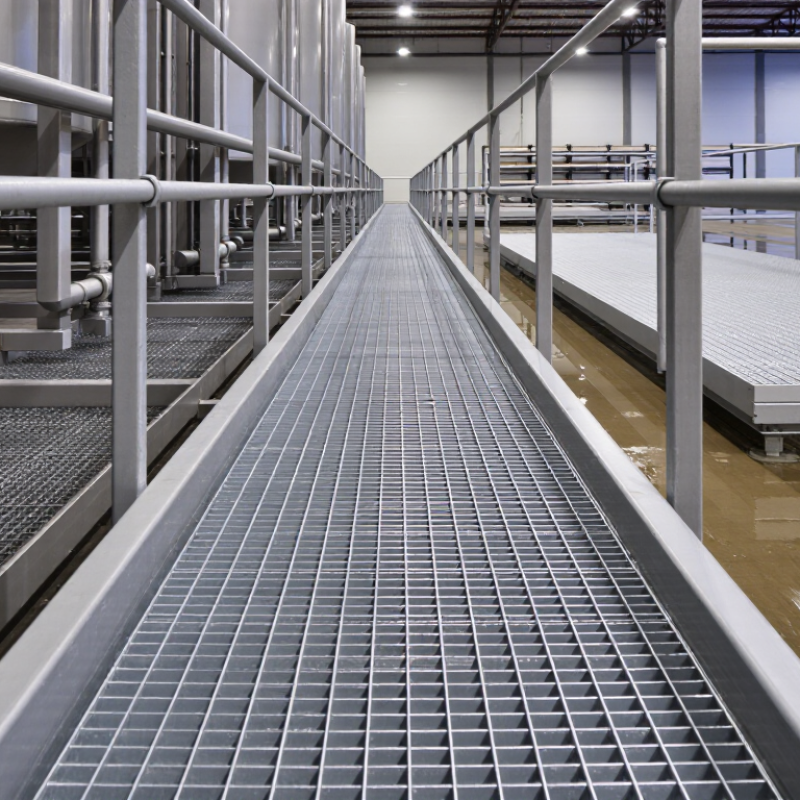
Selection note: Final grating selection should be based on verified design loads, clear span, support arrangement, allowable deflection, opening size, environmental exposure, slip requirements, fire requirements, and the standards applicable at the installation location.
Choosing the best floor grating in 2026 starts with the working environment, not appearance. A water-treatment platform needs open drainage and strong slip resistance. Molded FRP grating suits wet areas, corrosive vapors, and frequent washing. It is lightweight and electrically nonconductive. However, sunlight, fire requirements, and long-term deflection still need careful review.
For heavy machinery rooms, press-locked steel grating offers high load capacity and firm support. Specify bearing bar depth from the actual wheel loads, not a general equipment weight. Small openings help protect tools from falling through platforms. They can also hold more dirt. That trade-off is easy to miss. Aluminum grating reduces installation weight and works well on rooftops, walkways, and maintenance platforms. It may not suit severe impact zones or high-temperature service.
Hygienic production areas often require stainless steel grating, especially where cleaning chemicals and moisture are constant. Select a surface profile that supports safe foot contact without trapping residue. Ask for load tables, span limits, corrosion data, and tested slip performance. Local regulations may define opening sizes, guardrail interfaces, and fire behavior. Confirm those requirements before ordering. A practical site check should measure span, drainage direction, cleaning methods, and access frequency. Do not rely on a catalog image. It shows very little. The right choice balances safety, maintenance, installation time, and replacement risk. Rechecking the design after installation is worthwhile, because real traffic rarely matches the original estimate.
How to Match Grating Types With Industrial Applications
The chart compares common grating materials and manufacturing styles across typical industrial applications. Scores use a 1–5 comparative suitability index based on corrosion resistance, load performance, slip resistance, weight, hygiene requirements, and maintenance considerations. Final selection should be confirmed through project-specific structural calculations, local codes, and environmental conditions.
Selecting floor grating requires more than comparing steel weight or opening size. Safety, load capacity, drainage, and maintenance must work together.
For pedestrian areas, serrated surfaces improve grip around wet entrances and processing zones. Smaller openings also reduce heel traps and dropped-tool risks. Industrial platforms may need welded steel grating for heavy equipment and repeated wheel loads. However, capacity depends on span, bearing support, load direction, and impact frequency. A published load table is useful, but site conditions can change the result. Ask a qualified engineer to verify deflection and connection details.
Drainage performance depends on open area, slope, and cleaning access. Narrow channels can block quickly when leaves, mud, or packaging waste collect below. In coastal or chemical environments, corrosion-resistant materials may reduce maintenance. Protective coatings help, but damaged areas still require inspection. Check welds, fasteners, cut edges, and support seats during routine visits. Keep a simple record with photographs and measured wear.
Maintenance is often underestimated. A grating that drains well may still become slippery when grease accumulates. Pressure washing can hide loose joints rather than fix them. Inspect after storms, machinery relocation, or unusual impacts. Local safety rules and climate conditions also matter. No selection is perfect. A careful review of actual traffic, cleaning habits, and replacement access prevents costly assumptions.
Global buyers should define the application before comparing floor grating prices. Walkways, platforms, drainage channels, and industrial stairs require different load capacities. Specify span, uniform load, wheel load, deflection limit, and support direction. Do not rely on a product name alone. “Heavy duty” means little without tested values.
Standards must match the installation country and project authority. EN 14122 can guide machinery access platforms, while local structural codes may control loading and handrail design. For steel grating, request material grades, welding procedures, galvanizing details, and inspection records. Stainless steel may suit corrosive areas, but alloy selection still depends on chemicals, temperature, and cleaning methods. Ask for certificates. Check traceability from raw material to finished panels.
Customization should cover panel length, width, bearing-bar height, cross-bar spacing, surface finish, nosing, clips, and access openings. Serrated surfaces improve grip, yet they can retain dirt in food or clean manufacturing areas. This trade-off is often missed. Supplier selection needs more than a polished catalog. Review drawings, tolerances, sample panels, packaging, production capacity, and export experience. Confirm whether replacement panels can be produced later. A low quotation may exclude cutting, fasteners, testing, or port handling. Compare complete delivered costs. Allow room for correction; even approved drawings can contain a missed opening or awkward support condition.
Build your system. Protect your boat. Join the movement.